|
EE40 Formula
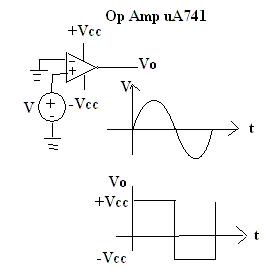
(609) Ideal Operational Amplifiers
1. Infinite input impedance
2. Infinite gain for the differential input signal
3. Zero gain for the common-mode input signal
4. Zero output impedance
5. Infinite bandwidth
(822) PSpice
E = Voltage controlled voltage source
F = Current controlled current source
G = Voltage controlled current source
H = Current controlled voltage source
RC RL Circuit Complete Response
X(t) = X(infinite) +[ X(0+) - X(infinite)] e^-t/tou
X is Voltage or Current, tou for Capacitor = RC, t is time
Capacitor
V(t) = V0*e^(-t/RC), RC circuit natural response
I(t) = C*(dV/dt), current across capacitor
I(t) =
V(t) = L*(dI/dt), voltage across inductor
<@ = cos @ + isin@ = e^(j@) , < is the sign for angle, here used for the sign
for phasor. @ to Telta sign. (196)(802)
j = -1/j , where j =sqrt(-1). (201)
Time Domain <-> LaPlace Domain
sin(wt) = w/(s^2 + w^2)
cos(wt) = s/(s^2 + w^2)
Step function = 1/s
Dicac's delta(t) = 1
e^(sot) = 1/(s-so)
Partial Fraction:
Case (a-i are all constants)
I. (dx + e) / (ax^2 + bx + c) = A/(fx + g) + B/(hx + i)
II. (cx^2 + dx + e) / (ax + b)^3 = A/(ax + b) + B/(ax + b)^2 + C/(ax + b)^3
III. (x^2 + 4x - 23)/ ((x + 3)(x^2 + 4)) = A/(x + 3) + (Bx + C)/(x^2 + 4)
IV. (-3x^3 - x)/(x^2 + 1)^2 = (Ax + B)/(x^2 + 1) + (Cx + D)/(x^2 + 1)^2
V. x^m(....) / x^n(...) use long division when m>=n
| 